Maximizing Performance and Minimizing
Cost of Ownership of RO/DI Systems
by Charles Mitsis, President, SpectraPure, Inc.
for ReefChat - 10/21/98
Introduction
Hello, my name is Charles Mitsis, President of SpectraPure, Inc. Our
talk tonight will be about optimizing the performance of your reverse
osmosis (RO) or reverse osmosis/de-ionization (RO/DI) system and minimizing
the cost of ownership. This discussion will focus more on the practical
aspects of water treatment rather than on theoretical.
Benefits of Using Pure Water in Reef Tanks
The benefits of pure water to the reef hobbyist are well documented:
elimination of nuisance algae and enhanced health of corals, invertebrates
and other marine wildlife. Currently the best technology for producing
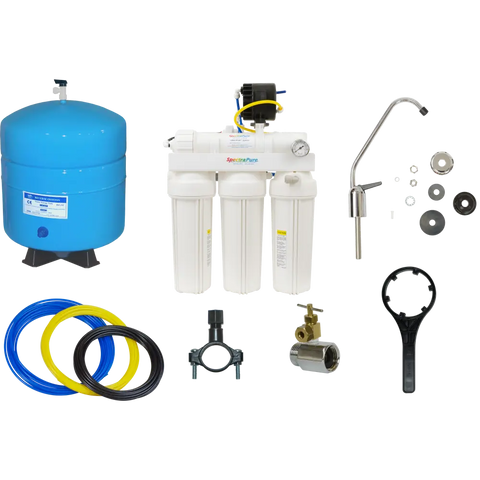
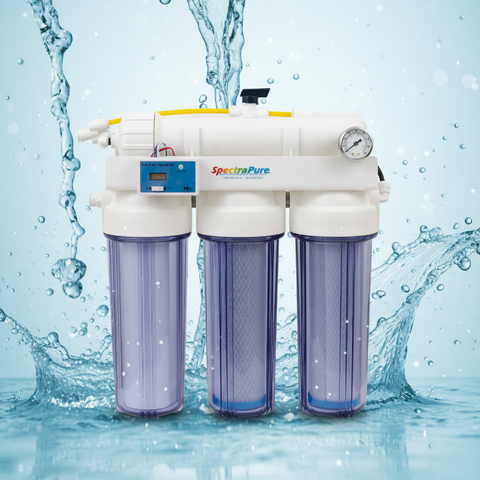
this ultra-pure water for reef tank use is the RO/DI system. The RO/DI
system is a set of discreet technologies which must be properly integrated
to optimize pure water production and minimize operation costs.
Basic System Design Considerations
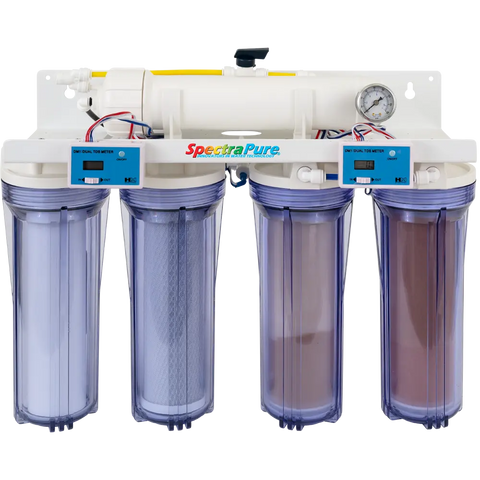
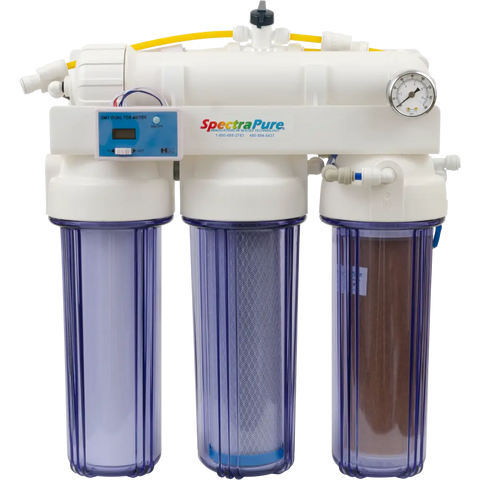
In a properly designed RO/DI system the most vulnerable and expensive
components are placed nearest the point of use and are protected by
upstream water treatment components which are less vulnerable and expensive.
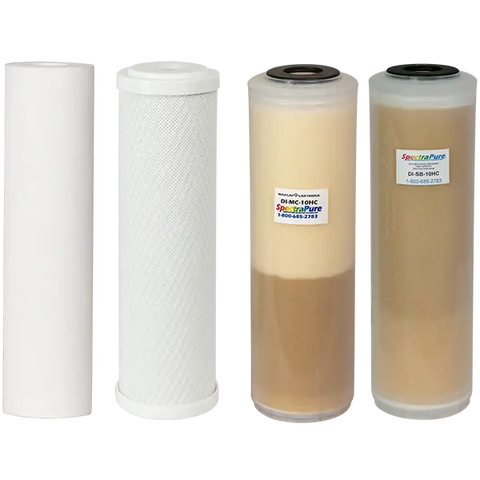
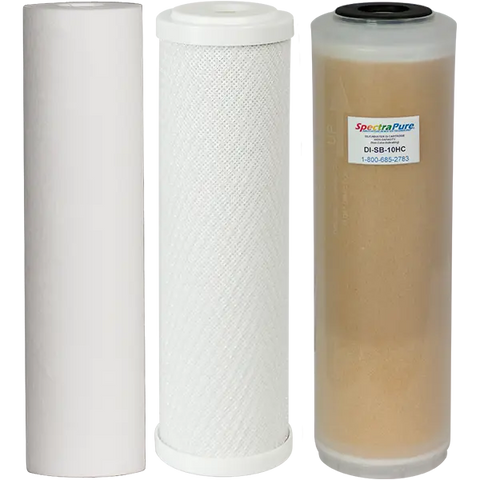
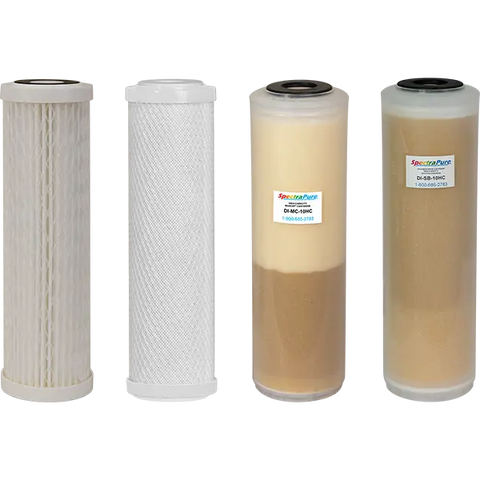
For example, the DI cartridge is the last component in the chain of
purification and is one of the most vulnerable and expensive. It is
protected by the preceding reverse osmosis membrane which in turn is
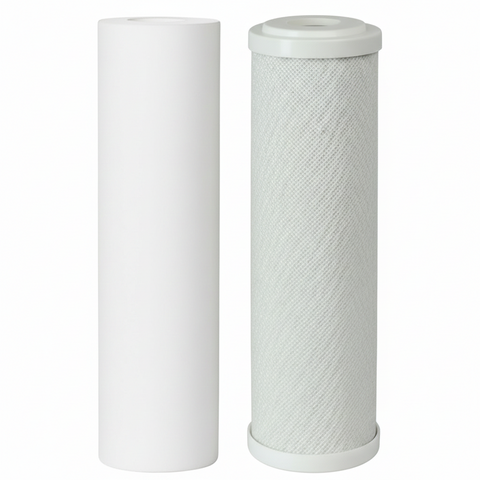
protected by the carbon block filter which is preceded by the sediment
filter. If any one of these critical components is not properly selected
or is of sub-standard quality premature failure of downstream components
can result.
Sediment Filters
First, let's talk about sediment pre-filters and the difference between
absolute and nominal micron ratings. In an absolute rated filter all
particles larger than the stated micron rating are removed by the filter.
In a nominal rated filter a certain percentage of particles larger than
the nominal rating will actually pass through the filter. The % efficiency
rating of the nominal rated filter tells you how many of the larger
particles will pass through. Most sediment filters are of the nominal
rating variety. String wound and spun filters have a low % efficiency
rating and offer little protection for downstream components. Resin
bonded sediment filters offer a very high nominal % efficiency rating
and offer good protection. New micro-sediment filters are absolute filters
and provide superior protection of downstream carbon filters and membranes.
Carbon Block Filters
Next in line are carbon block filters. The primary function of these
filters is to remove chlorine and further filter out sediment. They
are available in three ratings: 10 micron (removes chlorine for up to
3000 gallons), 5 micron (6000 gallons) and 0.5 micron (20000 gallons)
which is also effective in removing organic chemicals such as pesticides,
herbicides and trihalomethanes. Since carbon block filters are absolute
filters and are prone to plugging with sediment it is essential that
they are preceded by a very high efficiency sediment filter. The best
means of determining when to replace the filter is to test the waste
water stream for presence of chlorine. Any chlorine level above 0.1
ppm will cause damage to the membrane and indicates that the carbon
block filter must be changed.
Reverse Osmosis Membranes
The RO membrane is the workhorse of the water purification system.
It uses a thin film membrane technology to "electronically" reject impurities.
RO membranes are especially good at rejecting large atoms and molecules
and those species which exhibit relatively strong electronic charge.
It is less effective in rejecting small atoms and molecules (smaller
than water) and those with relatively weak electronic charge. RO membranes
will allow all dissolved gases (such as ammonia and carbon dioxide)
to pass through. The % rejection rating for a membrane is an indication
of how much of these impurities will pass through the membrane and on
to the DI cartridge. A membrane which has a 98% rejection rating will
pass only half as many of these impurities as one with a rating of 96%.
The direct result of using a 98% rejection membrane as opposed to a
96% membrane is that you will double your DI cartridge lifetime. It
is important to note that all membrane manufacturers adhere to a lower
% rejection limit for small membranes (2" x 10") of 96% at 60 psi and
that the only way to ensure that you are using a higher % rejection
membrane is to purchase it from a source which screens for higher %
rejection membranes.
De-ionization Cartridges
The DI cartridge serves as a final polish of the water before it sees
the actual application. The cartridge contains a mixed bed of anion
and cation resins which uses an ion exchange mechanism to remove impurities
that pass through the RO membrane such as silica, phosphates, nitrates,
ammonium and other trace impuities. Like a filter, the DI cartridge
must be monitored for performance and replaced when it becomes exhausted.
The best way to accomplish this is through use of a resistivity monitor.
Another way is through the use of color change resins which give a visual
indication of when the resins are exhausted. It is difficult to determine
the exact replacement point of color change cartridges which often results
in dumping of silica and other contaminants back into the water.
Applications for Reef Tank Enthusiasts
So how does a reef tank enthusiast go about selecting the right water
purification equipment and components? Selection starts with understanding
the feed water you will be using and the water purity requirements of
the wildlife you intend to care for. Water is a very complex medium.
In fact, it is technically a solvent and readily dissolves many materials
which we refer to as contaminants. The method of removal for these contaminants
determines what equipment and components must be employed in the design
of the water purification system. An aquarist who lives in an area which
has relatively problem free water and whose wildlife water purity requirements
are minimal may only need a stand alone RO system. More sensitive wildlife
such as corals and invertebrates will require the added water purification
performance of a DI cartridge. An aquarist in an area with problem water
may have to resort to difficult, relatively expensive solutions, especially
if the wildlife water purity requirements are high. Some of the more
serious problems encountered with feed water include:
Chloramine - chloramine is used by some municipalities to control
bacteria growth. It is a stabilized compound of chlorine and ammonia. Chloramine is extremely detrimental to many wildlife
species. Our 0.5 Carbon Block Pre-Filter effectivly removes the chlorine component but the ammonia passes through the membrane. Employing a single DI cartridge
will effectively remove the chloramine but the high concentrations
typically seen will rapidly exhaust the cartridge making this a very
expensive solution. Our dual cartridge combination of DI-SF-CI-10 followed by DI-AR-CI-10 is an effective and more economical way to remove the ammonia. An alternative method often recommended when soda-lime softening is used by the municipality is injection
of acid into the feed water prior to purification. The reduced pH allows the chloramine to be effectively removed by the membrane.
Carbon Dioxide - some areas have water which contains high levels
of carbon dioxide. While this is often not a big problem for wildlife
it is a very big problem for RO/DI systems. Carbon dioxide is a gas
and readily passes through the RO membrane and on to the DI cartridge
where it is removed, once again at great cost. The solution we most
often recommend is direct removal of the carbon dioxide through degassification
of the RO product water prior to introduction into the DI cartridge.
Understanding what is in your water and how it affects your wildlife
is crucial in determining the correct water purification equipment and
component design. No one system or combination of systems will work
for all water compositions and wildlife requirements. The best approach
to take is to first obtain compositional data on your feed water and
your wildlife. Water composition data is often available at no charge
from your municipal water treatment authorities. Wildlife requirement
information is available from a variety of sources including the internet,
books, or your local aquarium store. Many times your local aquarium
store can also give a recommendation for water treatment. Of course,
you are always welcome to contact the water purification specialists
at SpectraPure who will be very happy to assist you with designing a
system which will meet your needs and those of your wildlife.