|
% REJECTION CALCULATION FOR YOUR MEMBRANE
|
Use the calculator below to determine the percent
rejection of your RO system.
|
HOW TO CALCULATE ACTUAL PERFORMANCE FOR A REVERSE OSMOSIS MEMBRANE |
Actual performance of a membrane is dependent on three factors: Osmotic Pressure, Tap Water Pressure and Tap Water Temperature.
- What is Osmotic Pressure: The flow of water through a membrane in response to differing concentrations of solutes on either side generates a pressure across the membrane called osmotic pressure. In other words, as the hardness of the tap water increases, greater tap water pressure is required to force the water through the membrane.
- Pressure & Temperature Compensation: In order to characterize a membrane, there must be common testing data. Industry standards to testing membrane performance is: 60 PSI tap pressure with 77 degree water temperature.
Most locations will not have exactly 60 PSI or 77 degree water. Use the calculation below to determine what the membrane will do with your water conditions.
Why might my filter change frequency increase?
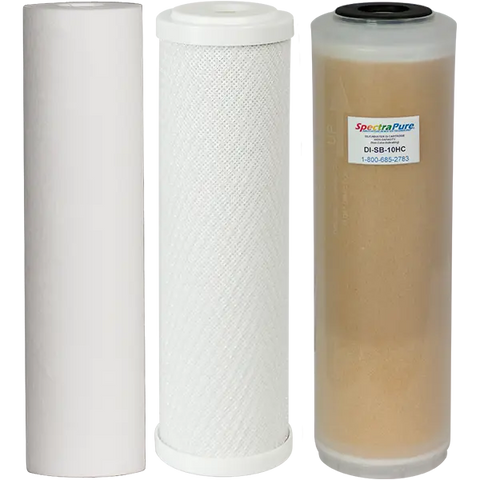
99% of the time the 0.5 sediment and 0.5 micron carbon filters work perfectly together, but there are a few water sources around the country that contain a high percentage of very fine sediment materials that are less than 0.5-micron, this is most likely one of those situations.
In these situations the 0.5 micron carbon filters tend to plug before the 0.5 micron sediment. The solution is to substitute the 0.2 micron ZetaZorb™ sediment filter for the 0.5 sediment filter.
In cases of extreme quantities of dirt in the tap water, another possibility is to add an additional 0.35 pleated sediment filter (in a new housing) before the 0.2 ZetaZorb™ and the 0.5 carbon.
It can be tough to diagnose the problem in "months" (time), not in "gallons produced" during that time. "Time" does not matter at all, only gallons produced matters and the total "GALLONS" processed should always be used to determine the filter life. (The gallon produce must include the brine volume in addition to the permeate volume).
Also, for long pre-filter life the ratio of brine to permeate should be checked to be sure it is no greater than 5 to 1. (The higher the ratio the shorter the pre-filter life.) This could also be part of the problem in any situation.
In addition, if there were to be an auto-shut-off device on the system, make 100% sure the brine water completely stops flowing and stays off when the system shuts-off.
There are a few cases where customers set-up the systems incorrectly without the proper shut-off devices. For instance, where a float is installed on a permeate line without an ASO valve or check valve, the system never shuts off the brine flow. There have been cases where the customer has installed a solenoid backwards thus allowing the brine water to flow continuously down the brine tube. All of these possibilities must be tested and checked before a good solution is determined.
IS DRINKING DI WATER OK?
When it comes to drinking DI water, there are many different thoughts on it. First thing you should understand is that DI water has all minerals removed. If ALL you were drinking was DI water and you did not eat anything, it would be harmful. Cells in the body need electrolytes (salts) to stay active and produce more cells. So, if you are not replenishing the electrolytes, the cells could not survive. To better illustrate this: Imagine that you have two batteries. One batter is connected to a glass container filled with tap water, the other is filled with DI water. Tap water is able to conduct the electricity through it because of the minerals. DI water cannot because the lack of minerals. It is only when you add salt to the DI water, that you would be able to conduct electricity.
DI water does not necessarily harm your health unless it is the only thing that you are putting into your body. We would not recommend drinking it because of its flat taste and because DI resins are not made of food grade, approved, material.
HOW DO I CLEAN MY PLEATED SEDIMENT FILTER?
STEP 1: Mix together 1 Tablespoon of bleach per each gallon of water 1. You will need approximate 5 gallons of water.
STEP 2: Place the Pleated filter in the water mixture and soak for 1/2 hour.
STEP 3: Spray off the Pleated filter with a hose until the filter has no chlorine odor.
QUESTION ON THE FISHY ODOR OF ANION RESINS
Type 1 Strong based Anion resins release very low levels of amines (trimethylamine). A very low threshold of 5 PPB or greater will cause a fishy odor to be noticeable. The odor is most noticeable when the resins are new and when they are at or near the point of exhaustion.
NOTE: Trimethylamine is also released by decomposing fish which also results in the same type of odor.
WHY IS MY DI CARTRIDGE NOT FILLING UP WITH WATER ALL THE WAY?
RO water is produced at a very slow rate, which is dependent on the water temperature, pressure and size of the membrane. The water trickles into the DI housing (on the outside of the DI cartridge) and is forced up through the center, leaving the DI housing.
There are two reasons that this housing will not fill with water. First, air trapped in the housing will not allow it to fill. Or, if the product line leaving this housing is sloped down, then you are gravity draining the water out of the housing. In either case, no harm is done to either the water or the DI cartridge.
CALCULATING CO2 AND ITS EFFECTS ON DI WATER PRODUCTION
Procedure for Aeration of RO product water
for CO2 removal in well and other low pH waters
Introduction
One of the most common reasons for low DI cartridge life is high carbon dioxide content in low pH waters. CO2 levels in low pH waters like well waters can be as high 50-100 ppm. Since carbon dioxide is a small dissolved gaseous molecule it passes right through the reverse osmosis membrane. Carbon dioxide is weakly ionized and is not detected in conductivity measurements, however it occupies the anion-exchange sites in the deionization cartridge significantly reducing their expected life-time. Therefore, CO2 removal from RO product water significantly enhances the life-time of the deionization cartridges.

Procedure for determination of CO2 level
CO2 levels in your water can be measured in a variety of ways:
1. Using a test kit from Hach or Lamotte company.
2. Using the nomogram on next page (pH and bicarbonate alkalinity measurements are required) (Figure 1).
3. Click on this link to determine you CO2 level: www.fishfriend.com/aquarium_co2_calculator.html

Procedure for aeration for CO2 removal
RO product water is collected in a 3 feet tall PVC column with an air stone resting at the bottom. Air from an air pump is pumped into the column with RO product water. Degassed water (almost free of CO2 ) is collected from the top of the column and then gravity fed into the Deionization cartridge (Figure 2).

WHY IS THERE A NOISE COMMING FROM MY AIR GAP FAUCET?
The noise is caused by the location of the drain saddle with an Air-Gap Faucet.
- The Air-Gap Faucet inherently makes a noise that is amplified when the water running from the drain saddle splashes into the water in the sink trap. The noise is most commonly heard on start-up or after filter changes by air being purged from the system. Once the air is expelled, usually after 5 min, the noise should subside.
- To purge air, rotate the system so the product and waste ports of the membrane are pointing up. Let the system run like this for 10-15 min. (When rotating the membrane housing like this, the air bubble is able to burp out the waste line. Just like a jar filled with water. As you rotate the jar, the air bubble will float to the top. You want the air bubble to be up towards the waste port on the membrane housing.)
- The noise can also be reduced if you relocate the drain saddle to a greater height and make sure that the waste line is as straight as possible.


DRAIN SADDLE LOCATIONS
HOW DOES THE PERMEATE PUMP REDUCE WASTE WATER BY 80%
The product water production rate is dependent on the pressure across the membrane, while the waste water production rate is mostly dependent on tap water pressure. As a bladder tanks fills with water, its back pressure quickly starts to reduce the working pressure across the membrane, while the waste water flows as always. A curve can be plotted that shows progressively worsening ratios as the tank continues to fill. Half-way through the filling time, the ratio is already 8 or 10 to 1 and can be higher than 20:1 at the moment the ASO valve shuts off completely. (The waste water reduction with a permeate pump is compared to a pressure-tank-ASO drinking water system without the pump).
The permeate pump makes the membrane perform like the bladder isn't there. Still, at best, 4:1
RO REJECTION DIFFERENCES
There is some confusion on RO membrane GPD ratings we would like to explain.
We have been testing our RO membranes for over 20 years to the industry standard of 60psi. This is a significant amount of data for us to draw upon when we share performance characteristics with our customers, help them troubleshoot production problems, or back up our ratings claims for that matter.
For example, the Filmtec 75GPD membrane that is so popular is rated 75GPD at 50psi. When we test it at the industry standard of 60 psi, the rating is 90GPD. The production rate of RO membranes is directly proportional to the applied pressure, thus the rating difference; this is why we sell our membranes and systems as 90 GPD (at 60 psi and 77F).
As a note, there are many other membranes that we frequently use besides Filmtec with as good or superior performance, and those manufacturers use the 60psi standard.
Unfortunately, most customers in the USA have less than 60 psi (or even 50 psi) available, let alone the 77F water temp that is used in the rating
process (average water temp is more like 50F across most parts of the country). In these cases a pressure boosting pump can obtain higher
production rates. If you live in Hades (Phoenix in the summer) the 77F is not much of a limiting factor as far as production goes. But for our
customers in upstate New York in January, it is a huge factor. Perhaps to be more realistic we should all rate membranes production on systems at 40 psi and 50F, although I doubt our competitors would drop their rating convention in this highly competitive market seemingly driven by perceived cost per gallon production rate.
Even more astounding, is that with the membranes that we hand-select and test to insure rejection greater than 98%, we typically see production rates exceeding 100 GPD at 60 psi (and 77 F) !!
If you look back at their literature, Filmtec started the 50 psi rating as a sales gimmick wherein they stated that FILMTEC membranes have the same production at 50 psi as the competitors membranes do at 60psi. Great way to snag customers, but it requires customers to look at the production rate charts and how they are derived to really compare membrane production rates.
Also, in our hand-selected and -tested Filmtec 75gpd membranes, we can make sure that you are purchasing greater than 98% rejection (look at their spec on the DOW web site, 96% is the bottom range of the guarantee! They are not all 98% like many think!....
http://www.dow.com/liquidseps/prod/tw30_181275.htm
Here is a listing of Nominal Rejection Characteristics of a (TFC) Membrane:
Why is 1 or 2% so important?? A 2 % increase in rejection from 96% to 98% can double your DI cartridge(s) life. Over the life of the membrane that can save you big $$$ in DI cartridges! That is why our hand selection and proprietary testing (we reject more than half that do not meet our SPEC of >98.0% rejection) is worth the extra cost. Who else labels their membranes with actual rejection rate on the so called "the same" membrane?
Hope this helps explain the different ratings that you see for what appears to be the "same" membrane.
DOES YOUR BODY NOT NEED THE MINERALS IN DRINKING WATER?
INORGANIC MINERALS:
It's believed that mineral water helps to furnish elements for your bodies metabolism. However, there is scientific proof to suggest that most of these minerals are in an inorganic (dead) form. While they may enter the circulation, they cannot be used in the physiological process of building human cells. With this in mind, we can see that mineral water may give "dead" or "inorganic" minerals to the body which cannot be properly assimilated. These inorganic minerals only interfere with the delicate and complex biology of the body. "The body's need for minerals is largely met through foods, not drinking water". - The American Medical Journal - (One glass of orange juice contains more beneficial minerals than thirty gallons of untreated tap water. Fact: Organic minerals in tap water represent only 1% of the total mineral content of the water.
ORGANIC, OR BIOAVAILABLE MATERIAL:
Only after they have passed through the roots of plants do these inorganic minerals become organic (through photosynthesis) and capable of being assimilated into our tissues as ORGANIC Minerals. Pure water removes the inorganic mineral deposits in your body. Organic minerals are fully absorbed and remain in your tissues. According to many nutritionists, minerals are much easier to assimilate when they come from foods.
ZERO TDS.. IS IT REAL
I thought I would comment on the common misnomer "ZERO TDS". Persons stating ZERO TDS I assume are referring to Zero Indicated TDS. What's the difference you ask? Well, quite a bit when you are really talking about ultra pure water. Ultra pure water is about 18.2 mohms or about 0.05 micro-siemens. Most Reefers are after such ultra pure water in our experience. Thus, if there were such a thing as "ZERO TDS", it might be more appropriately measured around 0.05 micro siemens. Unfortunately, most (not all) inexpensive TDS meters can resolve at best about 5 micro seimens. That is several decades less sensitivity than required to be stating so called "ZERO TDS".
While 5 micro siemens conductivity (at an affordable price and rugged instrument easily operated and maintained) is very reasonable for for break-through detection to signal cartridge replacement required, it is clearly not sufficient to measure or crow about having "ZERO TDS" . Thus, postings where one has "measured" a system or component performance and state they have "ZERO TDS" should be careful to quantify the accuracy of the instrument they are using to make such a claim. Hopefully this will shed some light on... zero is not always zero.
WHAT IS THE SHELF LIFE FOR FILTERS?
- PRE-FILTERS (Sediment & Carbon Block Filters)
Pre-Filters
do not have a shelf life, so stock up on these.
- REVERSE OSMOSIS MEMBRANE (RO)
Purchase an RO membrane when needed. If you would like to keep one on hand, you can store it in the refrigerator for up to 1 year. (Keep in its sealed, original packaging). If the membrane dries out, it will not produce water).
- DE-IONIZING CARTRIDGES (DI)
Replacement DI cartridges come shipped in a Mylar® Bag. Keep it in its sealed, original packaging until use. You can store it for approx 6 months.
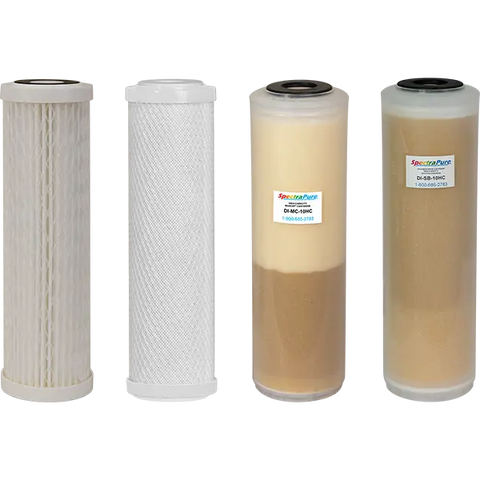
WHAT IS THE PROPER WAY TO REPLACE THESE FOUR FILTERS ON A MAXCAP® SYSTEM?
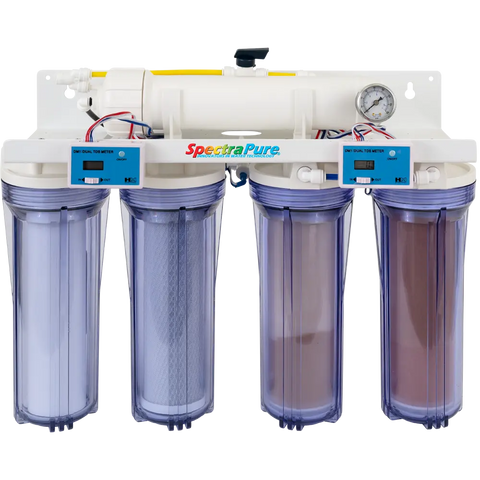
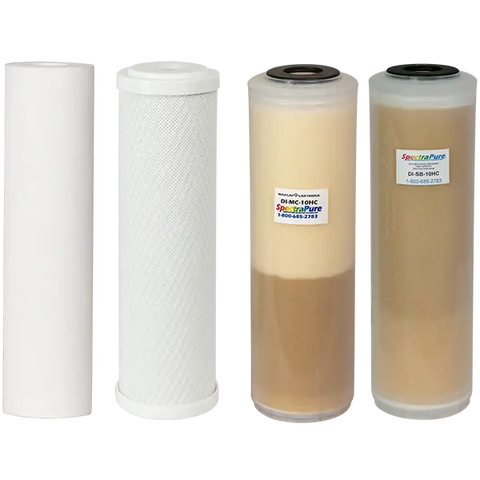
Put the sediment in the left housing, then the carbon in the second housing. Put the DI-MC-10 in the third and run water thru the 4th empty housing and to drain until the right meter IN probe reads 000. Then put in the DI-SB-10 and run to drain until the right meter OUT probe reads 000. That's it.
HOW BAD IS YOUR WATER
Here is a list of the known areas that have the most contaminants of arsenic, lead, halo-acetic acids and total trihalomethanes (linked to cancer), and total cloriform bacteria:
WORSE CASE AREAS |
MODERATE AREAS |
NOT TOO BAD |
Phoenix, AZ |
|
Nashville, TN |
Indianapolis, IN |
Philadelphia, PA |
Denver, CO |
Charlotte, NC |
Riverside, CA |
Baton Rouge, LA |
Los Angeles, CA |
Spokane, WA |
Kansas City, MO |
Fort Wayne, IN |
Atlanta, GA |
Norfolk, VA |
Billings, MT |
Aurora, CO |
Memphis, TN |
Yonkers, NY |
Dallas, TX |
Baltimore, MD |
Raleigh, NC |
Corpus Christi, TX |
Oakland, CA |
Greensboro, NC |
Lexington, KY |
St. Petersburg, FL |
Hartford, CT |
Arlington, TX |
Montgomery, AL |
Charleston, WV |
Buffalo, NY |
Honolulu, HI |
Houston, TX |
Detroit, MI |
Fremont, CA |
|
Orlando, FL |
Albuquerque, NM |
Modesto, CA |
|
Seattle, WA |
San Francisco, CA |
Fargo, ND |
If you are thinking that a standard filter in your refrigerator will be sufficient, think again. The filter in your refrigerator is meant to remove foul tastes and chlorine. It does not reduce the Total Dissolved Solids (TDS) like calcium, magnesium etc. Also to keep in mind, the refrigerator filter does not remove arsenic.
Yes. Your water tastes fine when it is cold, but try tasting your water at room temperature. You'll see the difference.
UNDERSTANDING HOW SPECTRAPURE DIFFERENTIATES ITS MEMBRANE I should preface this by saying that I have been a long time loyal SpectraPure customer and am posting this inquiry more to educate myself and hopefully others. I should also say that I just purchased 2 additional membranes from SprectraPure before writing this.
I would like to understand how SpectraPure differentiates its membranes (both tested and standard) from others on the market. As consumers what do we enjoy with SpectraPure that we can't get with others? What things do we need to be aware of when buying membranes? What are the specifics that justify the premium cost?
First, some useful background from our prior posts-
The RO membrane is the workhorse of the water purification system. It uses a thin film membrane technology to reject impurities. RO membranes are especially good at rejecting large atoms and molecules and those species that exhibit relatively strong electron charge. It is less effective in rejecting small atoms and molecules (smaller than water) and those with relatively weak electron charge. RO membranes will allow all dissolved gases (such as ammonia and carbon dioxide) to pass through. The % rejection rating for a membrane is an indication of how much of these impurities will pass through the membrane and on to the DI cartridge. A membrane that has a 98% rejection rating will pass only half as many of these impurities as one with a rating of 96%. The direct result of using a 98% rejection membrane as opposed to a 96% membrane is that you will double your DI cartridge lifetime. It is important to note that all membrane manufacturers adhere to a lower % rejection limit for small membranes (2" x 10") of 96% at 60 psi and that the only way to ensure that you are using a higher % rejection membrane is to purchase it from a source which screens for higher % rejection membranes. Spectrapure's membranes are treated with a proprietary process to enhance % rejection and production characteristics. We have been testing our RO membranes for over 20 years to the industry standard of 60psi. There is a significant amount of data for us to draw upon when we share performance characteristics with our customers, help them troubleshoot production problems, or back up our ratings claims, for that matter.
Production rates are another source of confusion. For example, the Filmtec 75 GPD membrane that is so popular is rated 75 GPD at 50psi. When we test it at the industry standard of 60 psi, the rating is at 90 GPD. The production rate of RO membranes is directly proportional to the applied pressure, thus the rating difference; this is why we sell our membranes and systems as 90 GPD (at 60 psi and 77F). Unfortunately, most customers in the USA have less than 60 psi (or even 50 psi) available, let alone the 77F water temp that is used in the rating process (average water temp is more like 50F across most parts of the country). In these cases a pressure-boosting pump can obtain higher production rates. If you live in Hades (Phoenix in the summer) the 77F is not much of a limiting factor as far as production goes. But for our customers in upstate New York in January, it is a huge factor. Perhaps to be more realistic we should all rate membranes production on systems at 40 psi and 50F, although I doubt our competitors would drop their rating convention in this highly competitive market seemingly driven by perceived cost per gallon production rate.
That said, with the membranes that we hand-select and test to insure rejection greater than 98%, we typically see production rates exceeding 100 GPD at 60 psi (and 77 F)!! If you look back at their literature, Filmtec may have started the 50 psi rating as a sales gimmick wherein they stated that FILMTEC membranes have the same production at 50 psi as the competitors membranes do at 60psi. Great way to snag customers, but it requires customers to look at the production rate charts and how they are derived to really compare membrane production rates. With our hand-selected and tested Filmtec 75GPD membranes, we can make sure that you are purchasing greater than 98% rejection (look at their spec on the DOW web site, 96% is the bottom range of the guarantee. They are not all 98% like many think). http://www.dow.com/liquidseps/prod/tw30_181275.htm Also, even more astounding, is that with the membranes that we hand-select and test to insure rejection greater than 98%, we typically see production rates exceeding 100 GPD at 60 psi (and 77 F) !!
Why is 1 or 2% so important?? A 2 % increase in rejection from 96% to 98% can double your DI cartridge(s) life. Over the life of the membrane that can save you big $$$ in DI cartridges! That is why our hand selection and proprietary testing (we sometimes reject more than half that do not meet our SPEC of >98.0% rejection) is worth the extra cost. Who else labels their membranes with actual rejection rate on the so called "the same" membrane?
Our experience has been that RO membranes are not “all the same”. That's why we back up with science the performance of our membranes which are a critical element in the performance of your system, albeit removal of harmful species or your cost to operate your system. Rejected membranes are sold to another, far less demanding market. The difference in price reflects some of our investment to perform the testing. The price difference between an untested and a tested membrane is lost in the savings if you obtain 1 or 2% improvement in rejection as your DI stage(s) life is drastically improved. Even our untested membranes are subjected to a proprietary process which increases their rejection ratio over the units purchased by other vendors from the same supplier. So, those who claim that all membranes from a particular vendor are the same may not be aware of our process by which we routinely see our average rejection increase over non treated units. DI cartridges are one of the highest operation cost factors for your system per gallon of water produced, thus our customers tell us the extra price paid is well worth the return from savings on Di. Others just want the best to take water production quality out of the equation as much as possible from their aquatic environment maintenance equation.
A quick note on how people often compare system performance in the field using common instrumentation:
I thought I would comment on the common misnomer "ZERO TDS". Persons stating ZERO TDS I assume are referring to Zero Indicated TDS. What's the difference you ask? Well, quite a bit when you are really talking about ultra pure water. Ultra pure water is about 18.2 mohms or about 0.05 micro-siemens. Most Reefers are after such ultra pure water in our experience. Thus, if there were such a thing as "ZERO TDS", it might be more appropriately measured around 0.05 micro siemens. Unfortunately, most (not all) inexpensive TDS meters can resolve at best about 5 micro seimens. That is several decades less sensitivity than required to be stating so called "ZERO TDS".
While 5 micro siemens conductivity (at an affordable price and rugged instrument easily operated and maintained) is very reasonable for for break-through detection to signal cartridge replacement required, it is clearly not sufficient to measure or crow about having “ZERO TDS” . Thus, postings where one has "measured" a system or component performance and state they have "ZERO TDS" should be careful to quantify the accuracy of the instrument they are using to make such a claim. Hopefully this will shed some light on... zero is not always zero.
In closing, we are not a company that simply buys from one source and sells to another. Critical Products like membranes, DI cartridges, filters, housings,gages, valves, pumps and pretty much everything we make or sell are exhaustively tested and analyzed in the lab and then in the field to make sure they meet our performance standards before you make your purchase. When you buy from us, you also get over twenty years of field experience. We have many unique technologies evidenced by our growing patent portfolio and a steady release of new products each year (the Silica Buster, spectra select membranes, the Liter Meter, the MaxCap®, the CLS, the UHE and more to come!) Simply put, we see ourselves as innovators trying to bring you the best performance products for the dollar, as in our experience "quality is remembered long after price is forgotten.).
Summary
1. Trust. Reputation. Quality. Performance.
2. The lower % rejection limit for most reputable RO membrane manufacturers is 96%. So even if you are buying a “98%” rejection membrane from our competition, you may actually receive a 96% rejection membrane.
3. A 2% loss of rejection costs you more money in the long haul with twice as many DI cartridge changes required from 2% less rejection.
4. All of the membranes SpectraPure sells are treated with a proprietary process to enhance % rejection and production characteristics.
5. We batch Q/C test our standard membranes to insure that within batch rejection and production variation is within manufacturers specifications. As a result, we actually reject some membranes and do not sell them to you. (They go to non-critical applications).
6. We individually test and guarantee our Select (-s) membranes to be greater than 98% rejection.
7. On spectra Select (-s) membranes we individually test and then write the actual performance on the membrane. You get in writing exactly what you paid for.
8. Production rates on our membranes often exceed stated GPD due to our proprietary treatment process. For example, our 90GPD often exceed 100 GPD.
PRODUCT WATER AND WASTE WATER CONNECTIONS ON THE MEMBRANE HOUSING

MY ICE MAKER WILL NOT MAKE ICE OR THE ICE MADE, IS SMALL . WHY?
Ice makers usually need at least 30 PSI to operate. If you are supplying RO water to your ice maker, you may have a problem.
The pressure of the RO water leaving a pressurized storage tank is dependent on the incoming tap water pressure. The pressurized tank will have about 1/2 - 2/3rds as much pressure as compared to the incoming tap water pressure. For example, If you tap water pressure is at 50 PSI, then the tank pressure will be about 25 PSI. Make sure when you are supplying water to an ice maker, that you have sufficient pressure for the ice maker to function.
IF YOU HAVE A PROBLEM WITH YOUR ICE MAKER DUE TO LOW PRESSURE, PLEASE CALL FOR AN ALTERNATIVE SOLUTION.
|