|
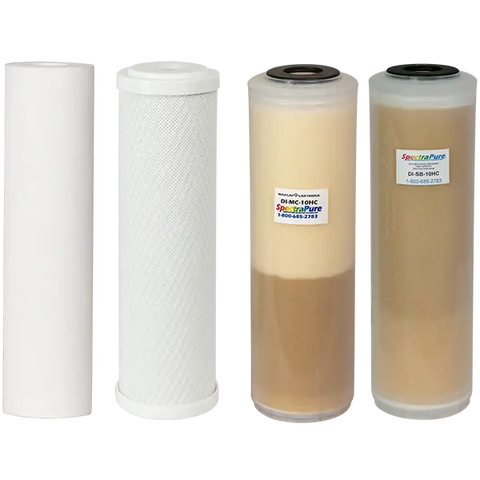
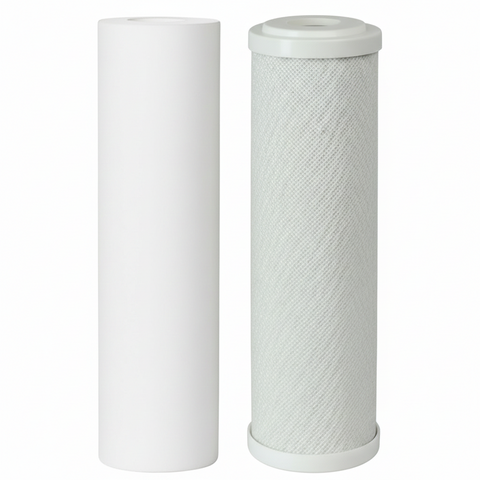
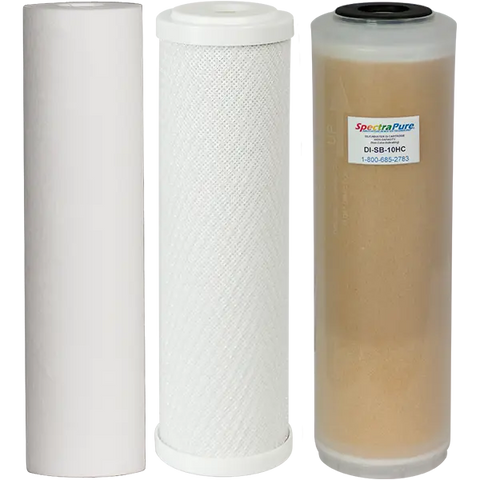
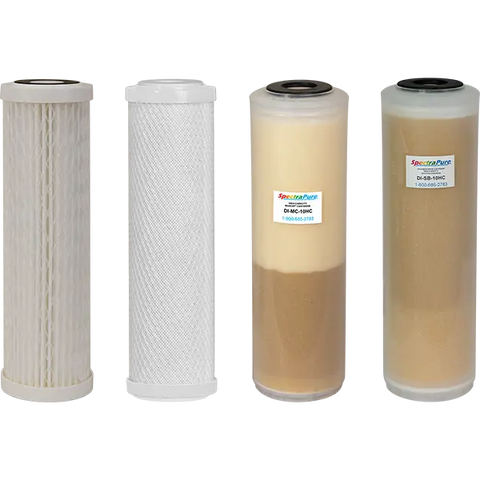
Sediment filters have specific ratings. They range from 10, 5, 1, 0.5, and 0.2 Microns. Water that comes from rivers can have high levels of particulate matter, so the micron rating of Sediment and Carbon Pre-Filters will affect the unit's performance, and also determines how often you need to replace each Pre-Filter. The Sediment Filter is a fibrous type filter. This filter removes particulate matter that could plug up the Carbon Pre-Filter and RO Membrane.
What is the difference between absolute and nominal micron ratings. In an absolute rated filter all particles larger than the stated micron rating are removed by the filter. In a nominal rated filter a certain percentage of particles larger than the nominal rating will actually pass through the filter. The % efficiency rating of the nominal rated filter tells you how many of the larger particles will pass through. Most sediment filters are of the nominal rating variety. String wound and spun filters have a low % efficiency rating and offer little protection for downstream components. Resin bonded sediment filters offer a very high nominal % efficiency rating and offer good protection. New micro-sediment filters are absolute filters and provide superior protection of downstream carbon filters and membranes.
A Sediment Filter will usually last approx. 4-6 months, depending on micron rating and quality of water. (The life span of the filter is determined by the turbidity, iron content, organics, and total particulate volume in your water source). The best way to determine when your Sediment Pre-Filter needs replacement is to use a Pressure Gauge. When you have a drop in pressure between 15-20% from where your normal house pressure is, replace filter. To check this, run water through the system without the filter in it's housing. If the pressure jumps back to your normal house pressure without the filter, you know the filter you just took out was plugged up.
-
CARBON BLOCK PRE-FILTER (2nd Stage Filter)
A Carbon Filter also has specific ratings that range from 5, 1 and 0.5. Each rating determines how much chlorine is removed in gallons of water. The 5 micron can remove chlorine for up to 6,000 gal, the1 micron for up to 9,000 and the 0.5 micron 20,000. This filter is in the 2nd stage. It removes chlorine, organics, heavy metals, trihalomethanes, pesticides and many other chemical pollutants. It will also break-up chloramines, which is chlorine bonded with ammonia ( removes the chlorine and leaves the ammonia).
(Only the 0.5 micron carbon block filter removes trihalomethanes, pesticides, volatile organic chemicals and 99.95% of giardia and cryptosporidium cysts.)
A Carbon Filter will usually lasts approx. 4-6 months ,depending on micron rating for the filters, usage and the quality of your tap water. The best way to determine when your Carbon Block Pre-Filter needs replacement is to use a chlorine test kit. Any chlorine level above 0.1 ppm will cause damage to the membrane and indicates that the carbon block filter must be changed.
- DRINKING WATER SYSTEMS (Post-Carbon Filter, after the membrane & tank)
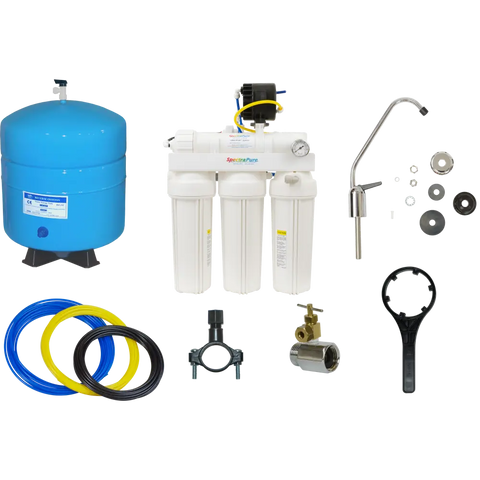
Drinking Water Systems most often have a final Post-Filter. This filter polishes the water as it leaves the Pressurized Storage Tank.
Once the water is Pre-Filtered, it is ready to be processed by the Reverse Osmosis Membrane.
- REVERSE OSMOSIS MEMBRANE (3rd Stage Filter)
Reverse Osmosis membranes reduce Total Dissolved Solids (TDS) that are present in the water. It also removes arsenic and fluoride. It is capable of rejecting salts, proteins, bacteria, sugars, particles, dyes, and other constituents that have a molecular weight larger than 150-250 daltons. Separation of ions with RO is aided by charged particles (dissolved ions that carry a charge), like salts, are more likely rejected by the membrane than those that are not charged. The larger the charge and particle size, the more likely it will be rejected.
To process the water, the membrane must be under pressure which is provided by your municipal water company or a well pump (i.e. your tap line pressure). If your pressure is below 40 psi, we recommend using a Booster Pump. A membrane should last approx. 2 or more years, depending on the quality of your tap water. (Membrane life is a factor that is determined by the tap water chemistry and total gallons produced per sq. in. of membrane material). The best way to determine when your RO Membrane needs replacement is to use a TDS meter.
An RO membrane naturally produces concentrated brine (waste) water. As some of the fluid passes through the membrane the rest continues downstream, sweeping the rejected species away from the membrane, in a concentrated brine water. The process is known as "cross flow" which allows the membrane to continually clean itself. The ratio that you need of waste vs. product water is 4/1. The ratio is achieved by adjusting a capillary tub called the Flow Restrictor.

There are several things that must be taken into account when purchasing RO membranes.
Just because the membrane has a Filmtec label on it does not mean that it is a good membrane. Many of them exhibit low rejection rates right out of the Filmtec box. Filmtec membranes are actually rated with a minimum specification of 96% rejection and -20% of the stated flow rating. (See the Dow / Filmtec website for details).
SpectraPure guarantees that the rejection rates and flow rates will be within Filmtec specs on our standard membrane series and at or greater than 98% rejection on our SpectraSelect Series (-S-) membranes. It is not an easy or inexpensive result to achieve. It requires a high level of diligent effort on our part to provide this service to our customers and ensure that the membranes are what they are advertised to be.
One additional factor to keep in mind is that a 98% rejection membrane will double the life of a downstream DI cartridge vs. that of a 96% rejection membrane. That 2% difference translates into far less cost per gallon for DI water due to the extended life of the DI cartridges. For anyone that demands high quality RO water or has DI cartridges downstream of the RO membrane the benefits received from purchasing our tested membranes exceeds the small additional cost that must be added to the cost of the membrane.
These are some of the most important reasons why our tested and guaranteed Filmtec membranes are worth the extra money. In our opinion, the extra effort that it takes to test and guarantee the membranes is well worth the extra cost and effort. Any customer that has a DI cartridge(s) installed downstream of the RO membrane will save a great deal of money on DI cartridges due to the reduced usage of the cartridges.
RO membranes alone are not capable of removing 100% of the impurities. This is where De-Ionization Cartridges come in.
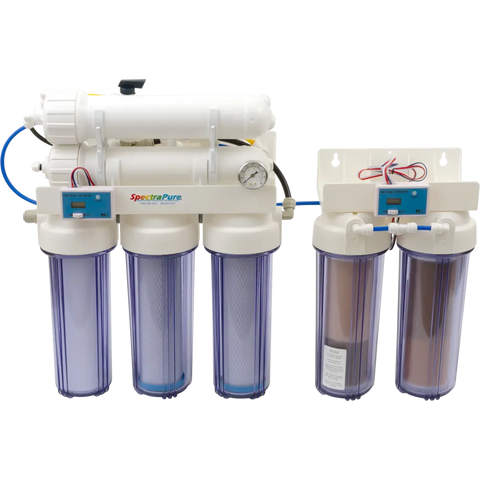
- DE-IONIZATION CARTRIDGE(S) (4th and or 5th Stage Filter(s). (Some systems have 2 DI Cartridges)
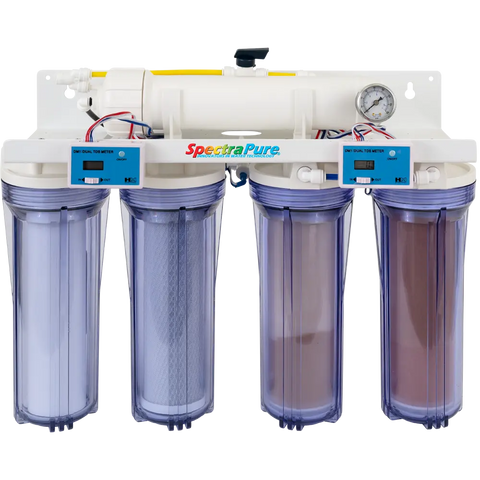
A DI Cartridge takes the remaining ionic load not removed by the RO Membrane and reduces it down to nearly "pure", which can be measured as 18 meg-ohms or 0.05 micro-siemens. This water is High-Purity grade water used in applications such as Laboratory & Aquarium use. Usually, systems that have 2 DI stages use a back-up method. When the first DI exhausts, the second DI takes over. (This prevents the leaching effect when a single cartridge is exhausted.) Systems like our MaxCap® RO/DI does not use the back-up method. This system has two types of DI cartridges that work together to have a life of 3x that of standard DI systems. The best way to determine when your DI Cartridge(s) needs replacement is to use a TDS/Conductivity meter. We recommend the COM100
A standard DI Cartridge will produce approx. 200-400 gallons of product water. In many applications, the MaxCap® DI Cartridge followed by a Mixed-Bed or Hi-S will process approx. 1200 gallons.
| Example: If the RO water entering a standard DI Cartridge has a TDS (Total Dissolved Solid) reading of 20 ppm, the cartridge may only process about 400 gallons of pure DI water. (You will go through 9 cartridges to produce 3600 gallons) The MaxCap® system will go through 4 cartridges to produce the same amount. |
|